
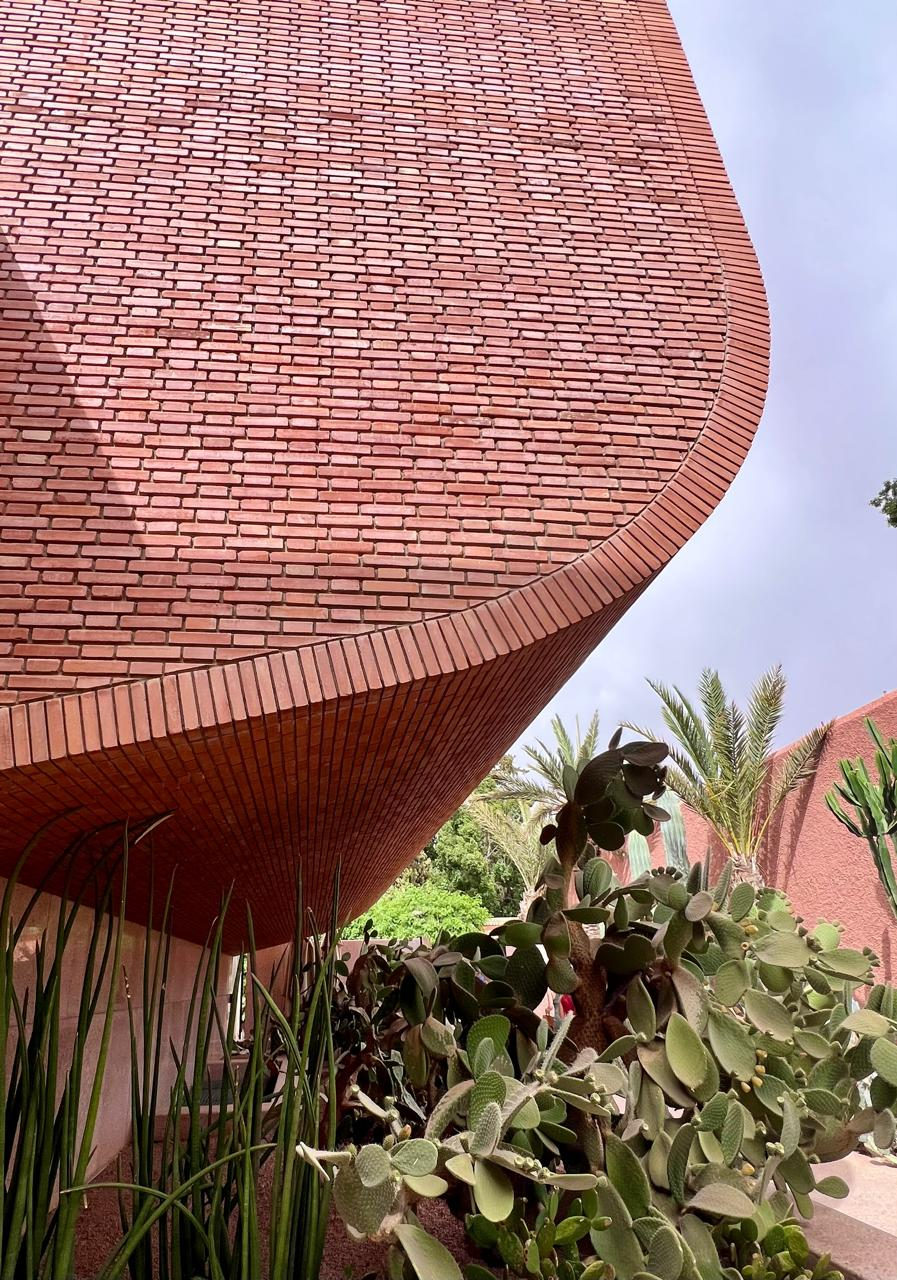
Traditional materials: brick and earth
The use of brick and earth as building materials is an integral part of Morocco’s architectural history. In the medinas of Fez, Marrakech and Chefchaouen, rammed earth and unfired brick are key elements that illustrate both local know-how and adaptation to the climate.
The traditional kasbahs and riads, typical of the southern regions and the Atlas Mountains, are built from fired clay brick or rammed earth. This choice of materials is no accident: earth is an excellent thermal regulator, keeping the temperature inside homes pleasant even at the height of summer, when outdoor temperatures climb.
Used in a modular way, brick lends buildings a certain uniformity while blending harmoniously into the country’s natural landscapes. It also allows a degree of flexibility and the adaptation of structures to local requirements, while providing a thermal comfort that is much appreciated in such a contrasting climate.
Majorelle blue: a unique chromatic identity
The intense blue of the Majorelle Garden in Marrakech, a symbol of Moroccan culture, has become one of the most emblematic colours of the country’s architecture. This blue, found on many traditional buildings and houses, stands out for its depth and its ability to create a striking contrast with the ochre tones of rammed-earth walls. It has become an aesthetic signature across the country, particularly in cities such as Essaouira and Marrakech.
Often called ‘Majorelle Blue’, this shade was popularised by the French painter Jacques Majorelle in the 1920s. Today, the colour is used not only for its beauty but also for its symbolic role. It is seen as a vibrant colour that links traditional architecture with a modern sensibility.
The modernisation of cities: a delicate balance
As Moroccan cities modernise at great speed, it is essential to maintain a dialogue between old and new. Modern architecture in Morocco is often inspired by local traditions while incorporating contemporary materials such as concrete, glass and steel. Casablanca, for example, is a model of constantly evolving modernity, where the clean lines of Art Deco architecture meet modern urban planning.
The recent transformations of cities such as Rabat, Marrakech and Casablanca reflect a desire to develop urban spaces while respecting a certain harmony with the cultural and historical environment. Adding contemporary buildings to the medinas or on the outskirts of the old cities is a real challenge, as it requires striking a balance between preserving heritage and embracing innovation.
Major property developments in new urban areas seek to incorporate elements of the local landscape: earthen façades, roof terraces and colours inspired by the natural palettes of Morocco’s regions. This creates a gentle transition between old and new, while meeting the needs of a growing urban population.
Modern architecture in the service of the landscape
Modern architecture in Morocco is not limited to adding concrete or glass structures to the landscape. One of the great achievements of contemporary Moroccan architects is their ability to design buildings in perfect harmony with the natural landscape. Whether for luxury hotels in the Erg Chebbi desert, houses in the Rif Mountains or public buildings in the heart of the medina, integration into the environment is essential.
Moroccan landscapes play a central role in architectural design. For example, contemporary architecture in the Atlas Mountains favours natural materials that blend into the setting while offering modern comfort. The use of pitched roofs inspired by traditional buildings, or of patios and inner courtyards, are strategies that maintain a certain continuity with older forms.
Conclusion
Moroccan architecture is a perfect illustration of how a culture can evolve while preserving its roots. The use of traditional materials such as brick and earth, the influence of Majorelle blue and the gradual modernisation of cities show that Morocco is a laboratory of ideas in which innovation draws on tradition. The key to this evolution lies in the ability of architects and urban planners to preserve local identity while addressing the challenges of growing urbanisation and necessary modernisation.
Ultimately, Moroccan architecture is far more than a simple question of style; it is the reflection of a dynamic culture, respectful of its past while looking resolutely towards the future.